

In 2017, the Value Added Tax Act, 2013 (Act 870) was amended to include provisions relating to withholding VAT agents. In the Memorandum to the Bill introducing this amendment, the Government explained that:
Clause 3 of the Bill seeks to empower the Commissioner-General to appoint a Value Added Tax Withholding Agent for the Authority. A person appointed by the Commissioner-General is required to withhold from the payment to a registered Value Added Tax trader, seven percent of the taxable output value of standard rated supplies; and at the time of making payment for the standard rated supplies, issue a Withholding Value Added Tax Credit Certificate in the form prescribed by the Commissioner-General to the supplier. Currently once a qualifying trader files a request for refund the Ghana Revenue Authority is obliged to refund to that person the amount whether the amount has been received by the Authority or not. The Authority therefore often ends up paying refunds of amounts that the Authority is yet to receive. To curb this, qualifying Value Added Tax registered entities whose supplies are zero-rated will be permitted to withhold seven percent of their payments as an advance payment. This will help to improve the cash flow of the traders by ensuring that they obtain a portion of their refunds in a timely manner. This will be extended to selected Government entities and other Value Added Tax registered entities to ensure that Government receives timely payment of Value Added Tax receipts.
The problem the Government said it was addressing was that it was making VAT refunds to qualified persons especially traders but was not receiving those VAT in the first place. That is, those who charged the VAT on supplies to the traders were not paying the output VAT to the Ghana Revenue Authority (GRA). However, the traders were coming to claim refund of the VAT they paid to the suppliers. In a perfect system, the amount the GRA would refund should have already been received. So, the Government decided to enlist the assistance of agents who will collect and pay part the output VAT potentially owed by the supplier. The Government settled on the rate of 7%.
Table of Contents
ToggleWho can withhold?
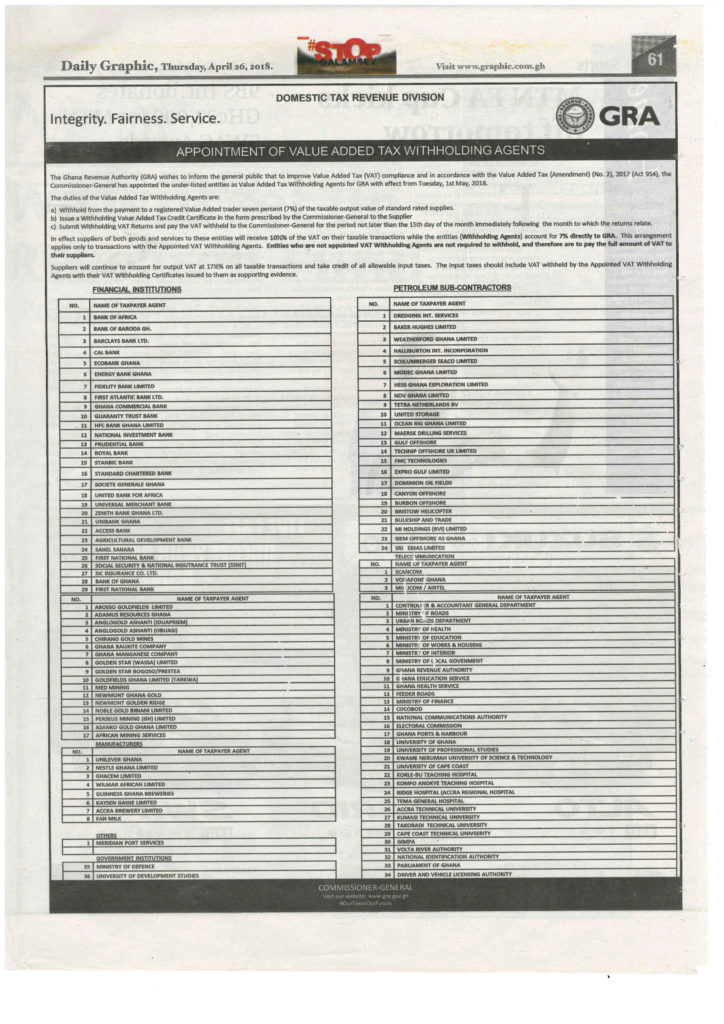
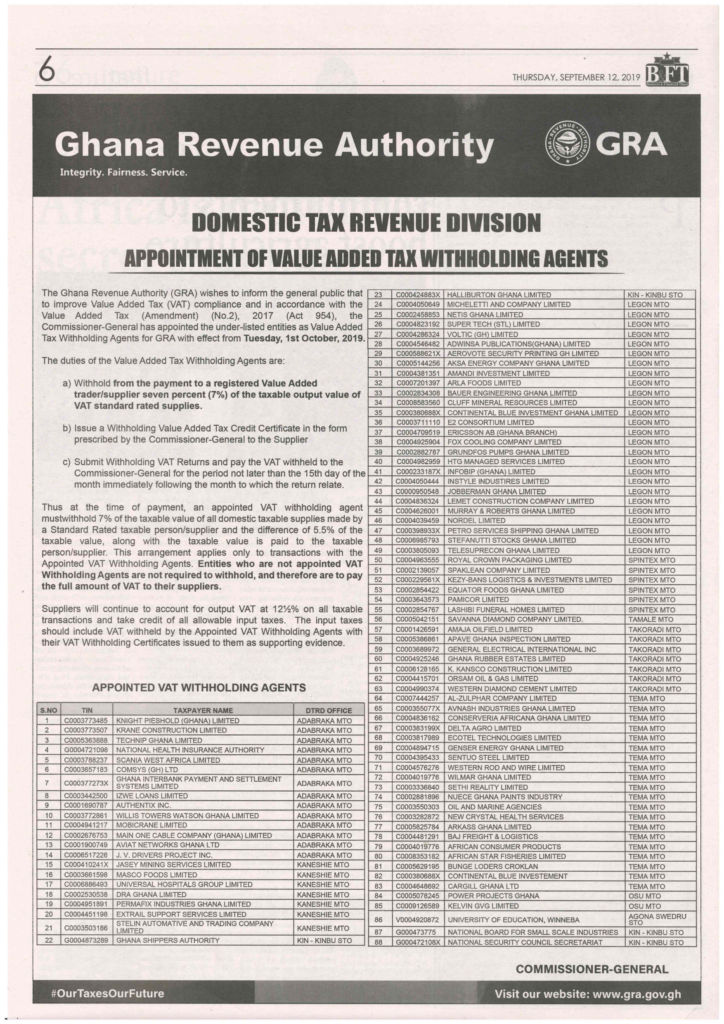
Every withholding VAT agent must be appointed by the Commissioner-General (CG). So, not everyone is entitled to withhold VAT. For withholding VAT, the agent must be specifically appointed and directed for this purpose. That means not every business is required to withhold VAT. Anyone registered for VAT can be appointed. The law provides for appointment of businesses making zero-rated supplies, Government agencies and any other VAT registered person. The GRA has published list of those appointed as withholding VAT agents. Some of those appointed are shown below:
How does it work?
The withholding VAT agent is required to withhold 7% of the taxable value. The taxable value is the base of the VAT, that is, the amount on which the VAT of 15% is applied. So, if the taxable value is GHS100, the supplier is required to charge VAT of GHS15 (15%) and the agent is required to withhold GHS7 (7%). When making payment, instead of paying the entire VAT charged of GHS15 to the supplier, the agent will pay the supplier GHS8 out of the VAT of GHS15 and remit GHS7 to the GRA. The return and payment are due by the fifteenth of the next month.
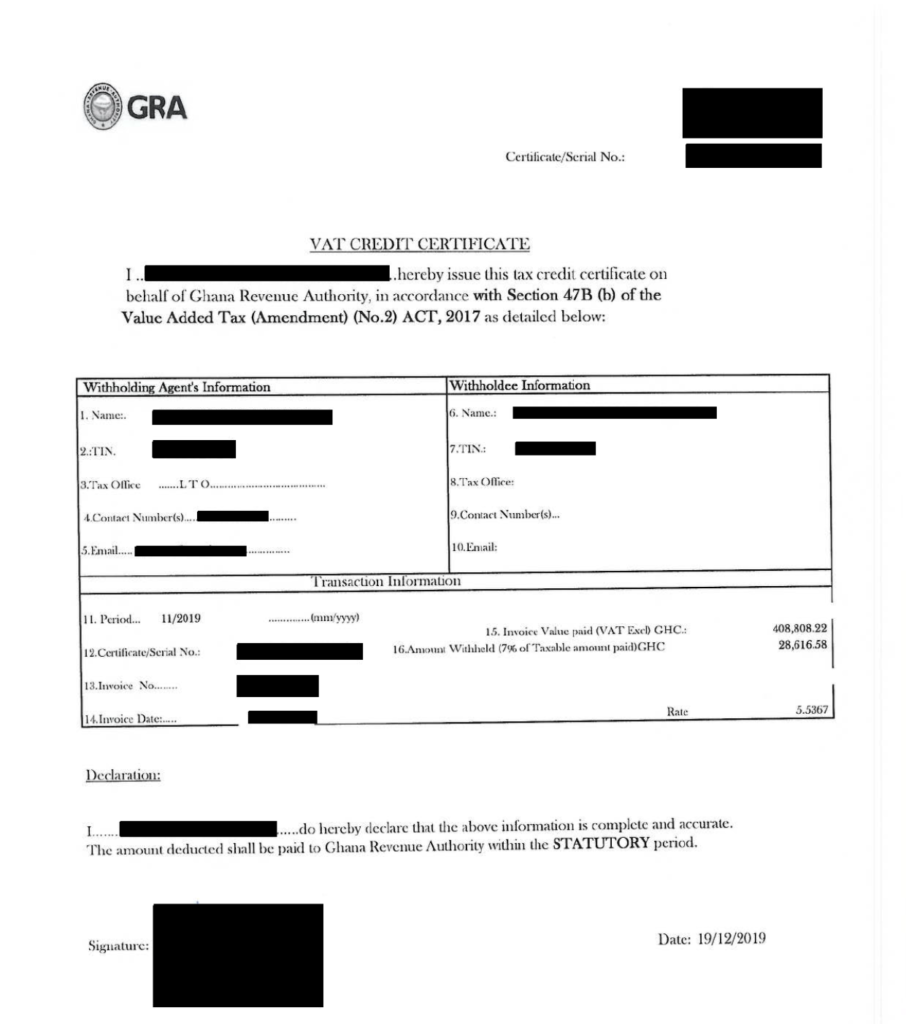
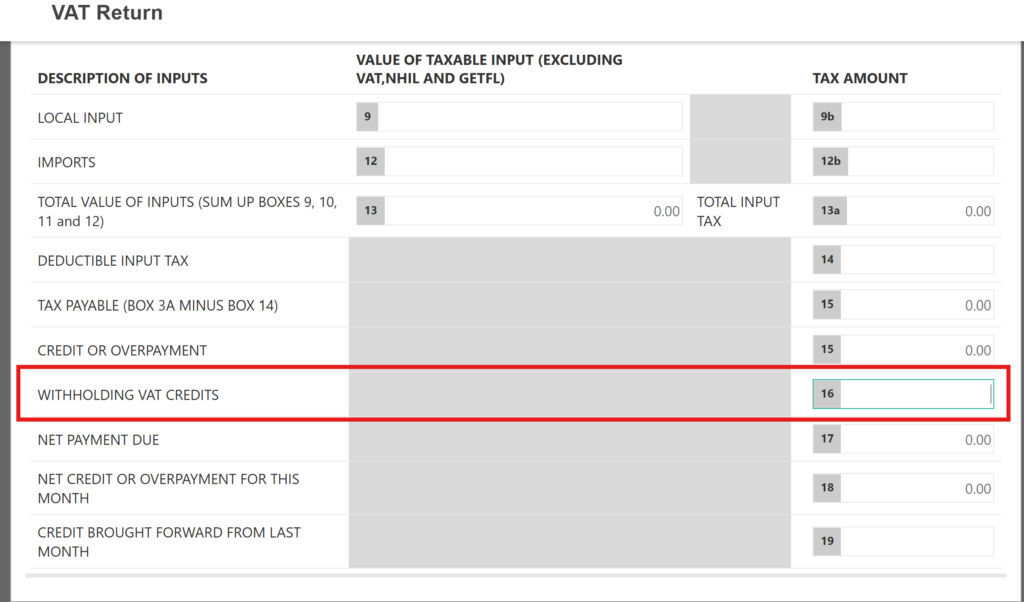
The agent will issue a certificate to the supplier covering the VAT withheld. Once the supplier receives the withhold VAT credit certificate, they can reflect it on their monthly VAT return. It must be reflected in the input section of the return, thereby reducing the output VAT to be paid. That is, in the output section, the supplier will still include the full VAT of GHS15 in the box for output VAT, and will include GHS7 in the withholding credit box in the input section. Assuming there is nothing else to declare, the net amount of GHS8 will be shown on the return as payable to the GRA when the supplier files the return.
Is this different from 7.5% withholding?
This is different from the withholding agent for income tax purposes. For income tax, every business, whether owned by an individual or a company is automatically required to withhold income tax when making some types of payments. There is no specific appointment process. The withholding income tax agent does not issue any credit certificate unlike the withholding VAT agent. The new VAT law empowers the GRA to exempt some suppliers from paying the advance tax. The CG must consider their satisfactory tax records when dealing with an application for the exemption.
Using the same example above, assuming the supply was for services, and the withholding agent is also a withholding VAT agent, an additional 7.5% will be withheld for income tax purposes.

Out of the total invoice value of GHS120, the customer will pay GHS105.5 to the supplier and GHS14.5 to the GRA.
Takeaway
If you have not received a letter or a formal notice from the GRA appointing you as a VAT withholding agent, you have no obligation to withhold VAT from any supplier. You have to continue discharging your normal withholding income tax duties. If a customer withholds VAT on you, obtain the certificate and use it on your monthly VAT return to reduce the amount payable.