

See the summary and the full judgment below. The full arguments before the Court can be found here.
Court: The Supreme Court of Ghana, Accra
Date of Judgment: 3 June 2026
Coram: Pwamang JSC (Presiding), Tanko Amadu JSC (Lead Judgment), Asiedu JSC, Gaewu JSC, Amaleboba JSC
1. Introduction & Context
The Supreme Court reaffirmed the long-standing common law principle that tax legislations must be strictly construed. The court emphasised that tax authorities do not wield unregulated powers, and procedural frameworks established by the legislature. Timelines must be rigorously enforced to prevent endless administrative cycles.
2. Background and Key Facts
- The Parties: Seadrill Ghana Operations Limited (the Appellant), a branch of an external Bermuda company operating as a subcontractor in Ghana, and the Commissioner-General of the Ghana Revenue Authority (the Respondent).
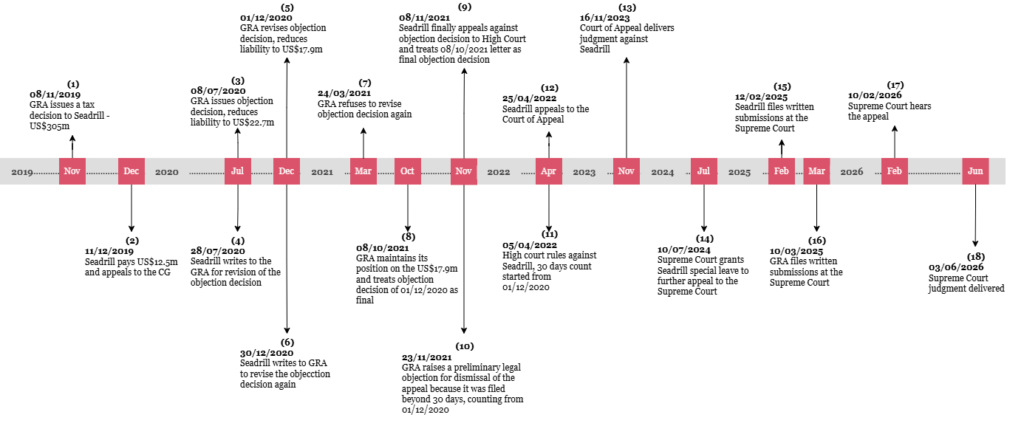
- The Assessment: On 8 November 2019, the Respondent served a tax audit assessment (covering the 2012–2018 years of assessment) totaling USD 305,606,164.19.
- The Disputed Communications:
- 11 December 2019 (1st Objection): Appellant objected via KPMG. Respondent exercised discretion under Section 42(6) of Act 915 to accept a reduced deposit of USD 12,500,000.
- 8 July 2020 (1st Objection Decision): Respondent revised the tax liability downward to USD 22,722,849.35.
- 28 July 2020 (2nd Objection): Appellant wrote back raising further objections; no new deposit was requested or paid.
- 1 December 2020 (2nd Objection Decision): Respondent further reduced the liability to USD 17,948,152.65.
- 30 December 2020 (3rd Objection): Appellant wrote again to dispute the 1 December 2020 figure.
- 24 March 2021: Respondent explicitly declined further review, stating the Commissioner-General lacked statutory power to review an objection decision further.
- 8 October 2021: Respondent issued a final administrative letter reiterating the 1 December 2020 liability as final and directing payment.
- The Appeal: The Appellant filed a Notice of Tax Appeal at the High Court on 8 November 2021 against the 8 October 2021 communication.
3. Procedural History
- High Court (5 April 2022): Struck out the appeal as incompetent. The court held that the 1 December 2020 letter was the operative objection decision. Time began running from that date, meaning the November 2021 appeal was filed woefully out of time.
- Court of Appeal (16 November 2023): Unanimously affirmed the High Court’s ruling, holding that administrative adjustments do not transform an objection decision into a fresh “tax decision”.
- Supreme Court Appeal: Mounted by the Appellant to overturn the concurrent findings of the lower courts.
4. Core Legal Issues
- Can an “objection decision” issued under Section 43 of the Revenue Administration Act, 2016 (Act 915) be legally characterised as a fresh “tax decision” capable of triggering a new round of objections under Section 42?
- Does Act 915 permit a rolling, iterative cycle of administrative objections and reviews?
- Did the Respondent’s letter of 8 October 2021 constitute a valid “objection decision” capable of restarting the 30-day statutory timeline to appeal to the High Court?
5. Holdings
- No. An objection decision under Section 43 is explicitly excluded from the statutory definition of a “tax decision” by virtue of Section 41(1)(d) of Act 915.
- No. The administrative review architecture under Act 915 is finite, structuring a single round of administrative review followed strictly by judicial oversight.
- No. The letter of 8 October 2021 was merely an administrative communication reiterating a prior position and providing updated payment directions, not a statutory objection decision.
6. Legal Reasoning & Analysis
Strict Exclusion Under Section 41(1)(d)
The Supreme Court observed that the dispute resolution mechanism under Act 915 is sequential and finite: the Commissioner-General makes a tax decision (Section 41), the taxpayer objects (Section 42), and the Commissioner-General issues an objection decision (Section 43).
Section 41(1)(d) explicitly states that a “tax decision” does not include an objection decision under Section 43. Because Section 42 only permits objections against a “tax decision,” it is legally impossible to lodge a statutory objection against an objection decision.
Interpretation of Section 42(9)
The Appellant argued that Section 42(9), which defines a tax decision as “the tax decision objected to, as may have been amended by an objection decision”, creates a rolling right to re-object to amended figures. The Supreme Court rejected this, clarifying that Section 42(9) is a narrow definitional clause mapping the identity of the original assessment through adjustments; it does not confer a substantive right to launch consecutive cycles of administrative review.
Functional Distinction of Powers
The court distinguished between:
- Section 39 (Adjusted Assessment): An independent power utilised by the Commissioner-General to ensure correct tax collection during audits or upon finding errors.
- Section 43 (Objection Determination): A distinct mechanism utilised to resolve a formal taxpayer challenge.
Varying a figure under Section 43 does not transform the outcome into a Section 39 adjusted assessment or a new taxable event susceptible to a fresh round of objections.
Pre-conditions to a Valid Objection (The 30% Deposit Rule)
Citing Kwasi Afrifa v. GRA, the court reiterated that paying the statutory 30% deposit of the tax in dispute (or securing an explicit, formal waiver under Section 42(6)) is a mandatory condition precedent to entertainment of any tax objection. The Appellant failed to pay a deposit or obtain a formal waiver for its subsequent letters, rendering them invalid as statutory objections. There can be no implied waiver of a statutory condition precedent simply because the tax authority responds to correspondence.
Principle of Finality
Allowing taxpayers to endlessly re-engage the tax authority after an objection decision would create an infinite administrative loop, rendering statutory appeal windows (such as the 30-day limit under Section 44 and Order 54 of C.I. 47) completely meaningless. Section 42(8) establishes that a tax decision not objected to within 30 days becomes final, underscoring the legislative premium placed on certainty and finality.
7. Ultimate Decision
The Supreme Court dismissed the appeal in its entirety and affirmed the concurrent lower court rulings. The 30-day clock to mount a judicial appeal commenced on 1 December 2020. Consequently, the appeal filed in November 2021 was heavily out of time and procedurally incompetent.
 Loading…

 Reload document
  Open in new tab