

During the presentation of the 2026 Budget, the Minister for Finance emphasized the need to review the Income Tax Act, 2015 (Act 896). Highlighting that the law required consolidation and simplification following multiple amendments, the Minister noted that an overhaul was necessary to keep pace with global tax developments and the digital economy. The Minister then announced that:
Pending the completion of this comprehensive reform, Government will strengthen provisions in the current Act to allow the collection of taxes from non-resident entities with significant digital or economic presence in Ghana. This ensures that global digital giants doing business in Ghana contribute their fair share to our national development.
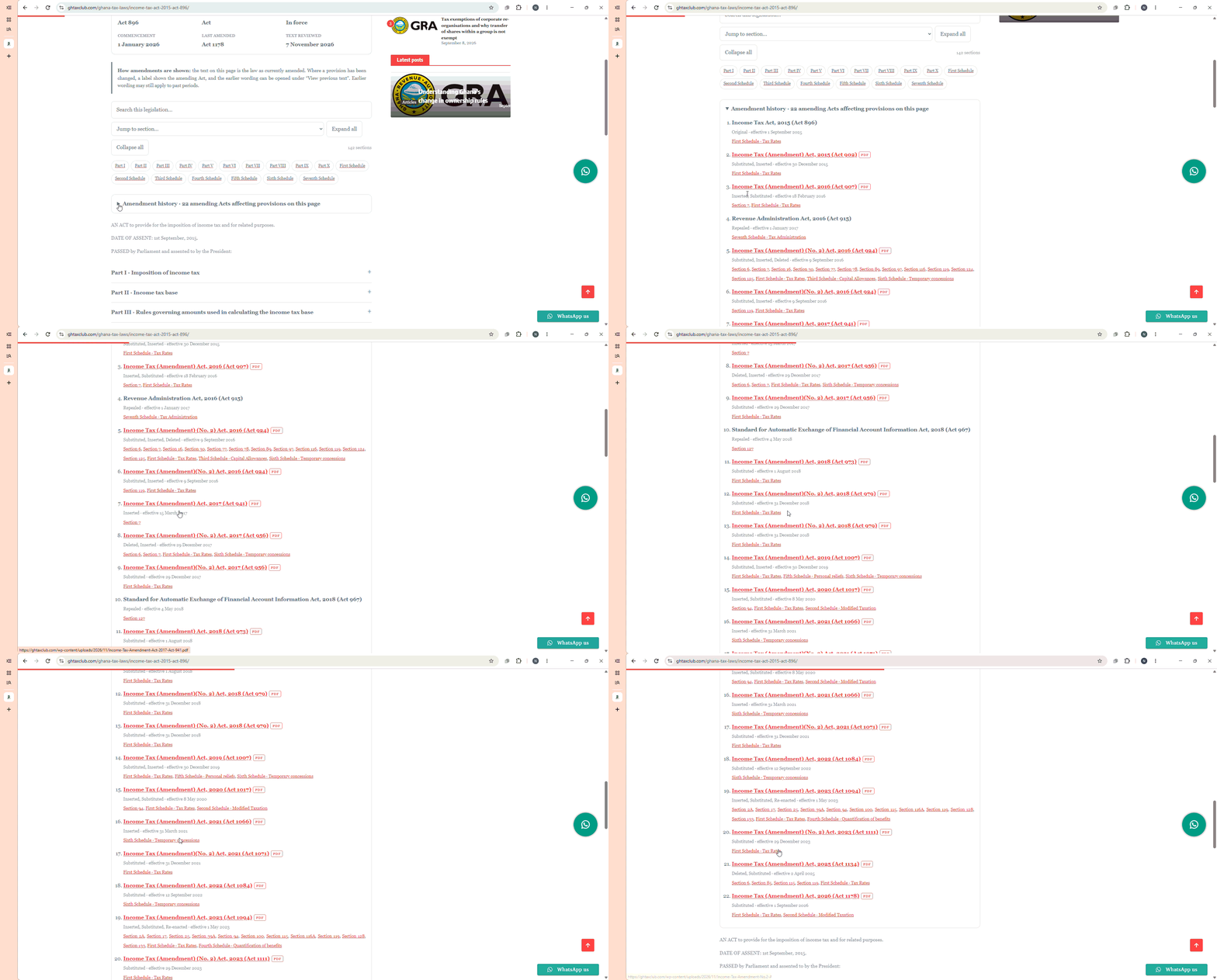
However, these interim amendments were not enacted in 2026. Instead, the government proceeded directly with the comprehensive overhaul. In the 2027 Budget, the Minister announced that a new Income Tax bill is currently being drafted following extensive consultations with taxpayers, businesses, and other key stakeholders. It is time for the Government to digitise the consultation process beyond a select sample of stakeholders. The Ministry of Finance and the GRA can open portals on their respective websites for the public to submit their comments. Meetings can also be advertised for members of the public to be involved in these extensive consultations. This is what is done in other countries. The South Africa Revenue Service does this where it even publishes the comments received, its reaction to them among others.
We agree that Act 896 has undergone numerous amendments. Given that new tax revenue measures are introduced every budget cycle, annual amendments are inevitable. Therefore, we recommend that, in addition to periodically drafting entirely new legislation, the Government should publish updated and consolidated versions of the existing tax laws as interim amendments are passed.
One of the major reforms to be introduced is the taxation of the digital economy and the concept of significant economic presence. Currently, Ghana fully taxes non-resident persons that have created a fixed place of business in Ghana. For those that do not have any physical presence in Ghana, if the service qualifies as a management or technical service, tax is withheld by a qualifying withholding agent. So, for services that are not performed in Ghana and may not qualify as management or technical services, tax is not paid in Ghana.
With significant digital or economic presence, the focus is on a resident person in Ghana making payment for these digital services. Countries have modelled this concept differently. Nigeria’s Tax Act, 2025 says:
a non-resident person shall, subject to any regulations that may be issued by the Minister to that effect, have a significant economic presence in Nigeria where the person transmits, emits or sends by itself or through other person, signals, sounds, messages, images or data of any kind by cable, radio, electromagnetic systems or any other electronic or wireless apparatus to Nigeria in respect of any activity, including electronic commerce, application store, high frequency trading, electronic data storage, online adverts, participative network platform, online payments, supply of userdata, search engines, digital content services, online gaming, cloud computing, online teaching services, and profit can be attributable to such activity
Kenya deems 10% of the gross revenue as taxable in Kenya while Nigeria attributes profit. It is not clear the direction Ghana would go. What is important is enforcement of the law. If the current withholding agents are made to withhold tax on payments, payments by individuals will not be covered. Since Ghana already uses the Sentinal System for collecting VAT on services provided by non-resident persons, financial institutions may be made to withhold the tax.
Finally, introducing the significant economic presence concept may trigger the renegotiation of existing contracts. Non-resident service providers may seek to pass the new tax burden onto Ghanaian residents by inserting gross-up clauses. These clauses guarantee a net payment amount to the provider, ensuring that any withheld taxes are borne entirely by the resident payer.